Why product cost matters for pricing
Many nail techs set prices based on what competitors charge, what clients expect, or what feels "reasonable" — without ever calculating what their service actually costs to deliver. The result is prices that may look competitive but leave very little profit after materials, time, and overheads are accounted for.
Knowing your product cost per service is the foundation of profitable pricing. It lets you calculate your actual profit margin, identify which services are more profitable, and confidently justify your prices to yourself (and occasionally to clients who push back).
What to include in your product cost
| Product category | Examples | Notes |
|---|---|---|
| Prep products | Dehydrator, primer, nail dust removal | Low cost per use but used every service |
| Base products | Base coat, BIAB, builder gel | Higher cost; heavier usage |
| Colour | Gel polish, chrome powder, pigments | Variable; depends on colour frequency |
| Topcoat | Top coat, matte topcoat, no-wipe topcoat | Used every service |
| Extension materials | Acrylic powder/liquid, Gel-X tips, forms | High cost; only for extension services |
| Consumables | Files, buffers, lint-free wipes, foil, gloves | Per-client cost; replace regularly |
| Solvents/removers | Acetone, isopropyl alcohol, cleanser | Low per-use cost; used every service |
How to calculate cost per service
The method:
- List every product used for that service — be thorough. Every brush-full counts.
- Calculate cost per unit of each product — divide the product price by the number of uses you get from it. Example: a £12 bottle of base coat lasts 80 uses = £0.15 per use.
- Estimate quantity used per service — one coat of base coat = 1 use; two coats of colour = 2 uses. For bulk products (like acetone), weigh before and after or estimate volume.
- Add up all per-service costs — this is your product cost for that specific service.
- Add a 10–15% waste factor — to account for product that doesn\'t make it onto the nail.
Worked example: gel manicure
| Product | Pack price | Uses per pack | Cost per use | Uses per service | Service cost |
|---|---|---|---|---|---|
| Nail dehydrator | £8 | 150 | £0.05 | 1 | £0.05 |
| Primer | £10 | 100 | £0.10 | 1 | £0.10 |
| Base coat | £12 | 80 | £0.15 | 1 | £0.15 |
| Gel colour (2 coats) | £8 | 40 | £0.20 | 2 | £0.40 |
| Top coat | £12 | 80 | £0.15 | 1 | £0.15 |
| Disposable file | £0.50 each | 1 | £0.50 | 1 | £0.50 |
| Disposable buffer | £0.40 each | 1 | £0.40 | 1 | £0.40 |
| Lint-free wipes | £5 per 100 | 1 | £0.05 | 3 | £0.15 |
| Gloves | £6 per 100 | 1 | £0.06 | 1 | £0.06 |
Subtotal: ~£1.96
With 15% waste factor: ~£2.25
Using the number to price correctly
Product cost is one component of your total cost per service. The full calculation:
Use the nail tech pricing calculator to run this calculation for each service. See also: how to price nail services for profit.
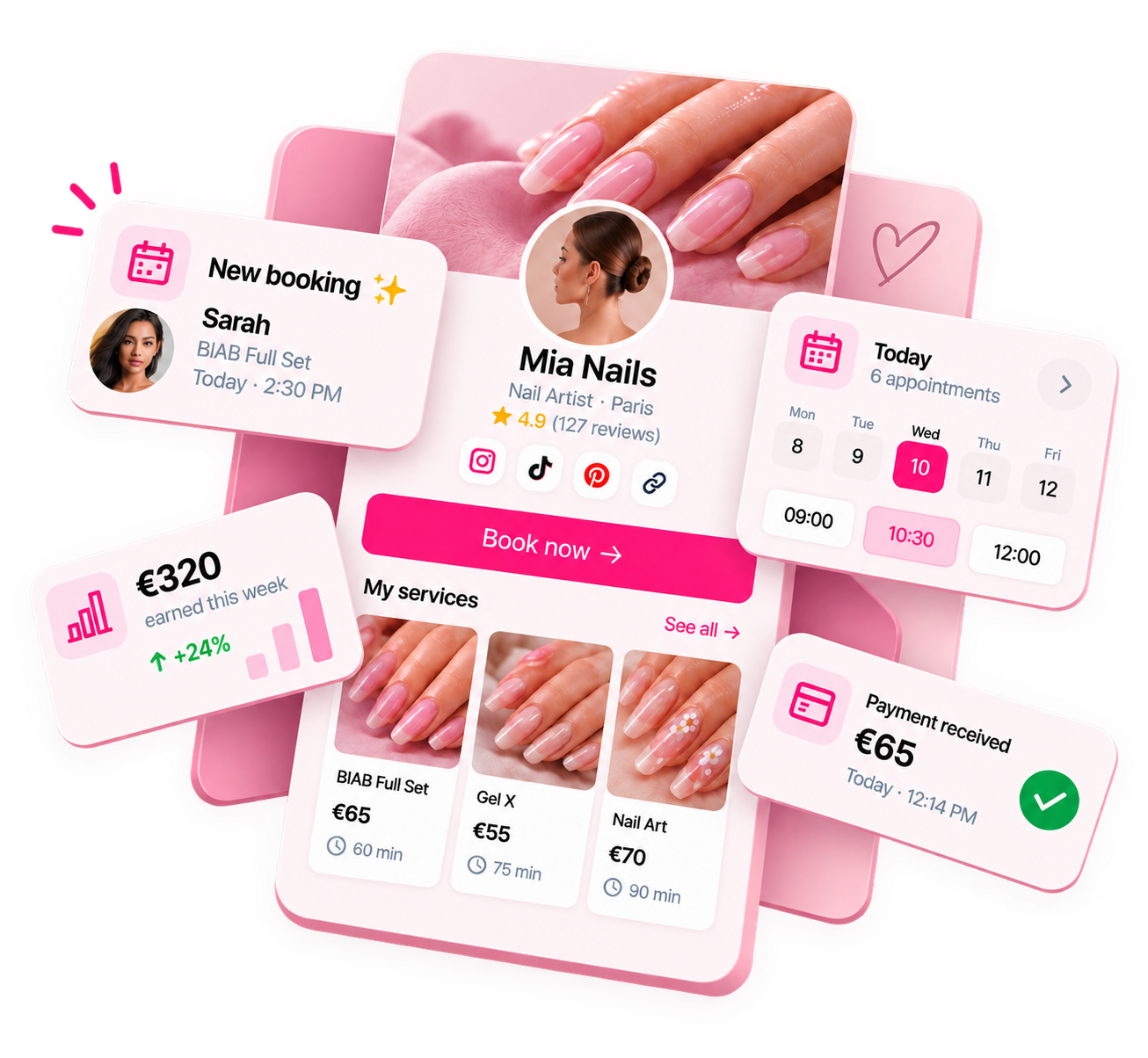
Ready to run your nail business more professionally?
Manage bookings, deposits and payments from one customisable Nelsy booking page.
Start free →Frequently asked questions
What percentage of my nail appointment price should be product cost?
A common benchmark in beauty services is 10–15% of the service price as product cost. If your gel manicure is £40, product cost of £4–6 is in a healthy range. If your product cost is 25–30% of the service price, your pricing may need review. These are guidelines rather than rules — the more important metric is whether your total costs (product + time + overheads) are covered by your prices with a meaningful profit margin remaining.
Do I need to track every drop of product?
No — but you do need a reasonable estimate. Weighing product before and after a service a few times to establish an average is more accurate than guessing. For products you use in larger quantities (base coat, top coat, dehydrator), tracking per-bottle usage over a week and dividing by client count gives a reliable average without obsessive tracking.
How do I account for product waste?
Build a 10–15% waste factor into your product cost estimates. Some product is lost in the process — product brushed onto the cuticle and removed, colours that dry before use, products that expire. If you notice your actual costs are higher than estimated, increase the waste factor.